
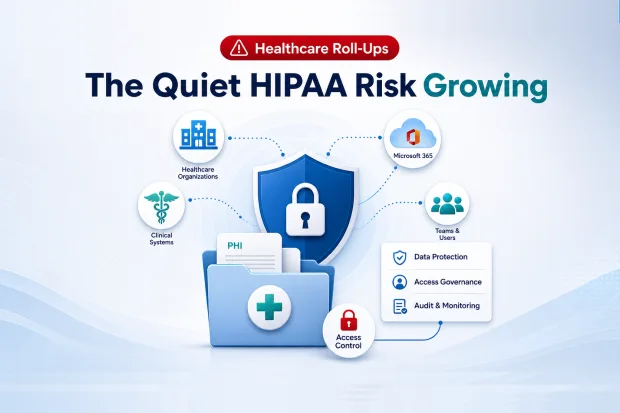
Healthcare private equity firms move fast. A dental group, urgent care platform, behavioral health company, veterinary group, or other healthcare business may acquire several smaller practices within a short period of time.
That speed helps the platform grow. But it can also create a serious HIPAA compliance risk if each new practice brings different systems, weak controls, and unclear patient data processes.
Every acquired practice has its own way of handling email, files, patient records, staff access, Microsoft 365, passwords, and security settings. Some practices may already have strong systems in place. Others may be using outdated tools, shared accounts, weak login settings, or older systems like on-premises Exchange.
At first, these issues may look small. But across a growing healthcare roll-up, small gaps can quickly become a larger compliance problem.
Why HIPAA Risk Builds Up in Healthcare Roll-Ups
Healthcare private equity roll-ups are built for speed. Deals may happen every few months, and the focus is usually on adding locations, increasing revenue, and improving operations.
HIPAA (Health Insurance Portability and Accountability Act) compliance moves on a different timeline.
It takes time to review systems, check Microsoft 365 settings, confirm the right agreements, update policies, train staff, secure email, review user access, and make sure patient information is being handled properly.
This creates a gap between the speed of acquisitions and the time needed to fix compliance issues.
Over time, the platform may end up with many locations working in different ways. One practice may have strong email security, proper audit records, and clear patient data controls. Another may share passwords, use personal accounts, or send patient information through unsafe channels.
That difference is where compliance debt begins.
What Compliance Debt Means
Compliance debt means risk that was not fixed early and becomes harder to manage later.
In healthcare PE roll-ups, compliance debt often shows up as:
- Patient information stored in the wrong places
- Weak email and file-sharing controls
- Poorly managed Microsoft 365 accounts
- Missing HIPAA training records
- Unclear access to patient data
- Inconsistent retention policies for PHI
- Different policies at every location
One issue at one clinic may seem manageable. But if similar issues exist across many acquired practices, the risk becomes much bigger.
This can lead to failed audits, delayed integrations, higher remediation costs, regulatory exposure, breach investigations, and loss of trust with patients, providers, and business partners.
That is why HIPAA should not be treated as a small IT task after closing. It should be part of healthcare acquisition due diligence and post-close integration from the beginning.
Why Microsoft 365 Matters for HIPAA Compliance
Many healthcare practices use Microsoft 365 for email, documents, calendars, and communication. Microsoft 365 can support HIPAA-regulated work when it is set up correctly, managed properly, and used with the right agreement in place.
But using Microsoft 365 does not automatically make a practice HIPAA-ready.
The setup matters.
A healthcare platform should know how each acquired practice is using Microsoft 365. At a minimum, the platform should understand:
What Microsoft 365 plan the practice is using
Whether the Business Associate Agreement with Microsoft is in place
Whether multi-factor authentication is turned on
Whether old login methods are blocked
Whether encryption and secure sharing controls are enabled
Whether audit logs are being kept
Whether retention policies are aligned for PHI (Protected Health Information)
Whether sensitivity labels are used for patient data
Whether eDiscovery readiness is in place for legal or investigation needs
This becomes harder when every acquired practice has its own Microsoft 365 environment.
Reviewing one practice is manageable. Reviewing 20, 40, or 100 practices requires a clear process and a portfolio-level view of risk.
That is the native tool gap many healthcare roll-ups run into. Microsoft 365 has strong tools inside a tenant, but it does not give platform teams a simple, built-in way to compare HIPAA posture across every acquired practice side by side.
Without that portfolio-level view, Microsoft 365 HIPAA compliance gaps can stay hidden until they become expensive to fix.
The Real Business Risk for Healthcare PE Firms
The biggest danger is not always one large breach. Often, the bigger risk comes from many small problems that build up quietly.
One clinic may have weak email controls. Another may not review who has access to patient data. Another may keep files in the wrong place. Another may not have completed staff training. Another may not have proper audit log retention.
Each issue may seem minor on its own. Together, they can create serious business risk.
For healthcare PE firms, that risk can show up as higher integration costs, delayed system consolidation, regulatory questions, breach investigations, patient complaints, litigation support issues, and reputational damage.
HIPAA enforcement can also become expensive. Fines can vary depending on the facts, the level of carelessness, the number of affected people, and how the issue was handled. In serious cases, penalties can reach large amounts per violation category.
That is why leadership should not wait for a breach, audit, or regulator letter to understand where the weak spots are.
If regulators, patients, lenders, or business partners ask questions later, the platform needs to show that it had a clear process for managing HIPAA risk.
That process should not begin months after closing. It should begin before closing and continue from Day 1.
A Simple HIPAA Onboarding Plan for Every New Practice
The best healthcare roll-ups use a simple, repeatable HIPAA onboarding checklist for every new acquisition.
The goal is not to create a complicated process. The goal is to make sure every practice is reviewed in the same way, using the same baseline.
Before the Deal Closes
Before closing, the buyer should ask basic questions about how the practice handles patient information.
This includes what email and file systems are used, what Microsoft 365 plan is active, whether the Microsoft BAA is in place, who has access to patient records, whether shared mailboxes are used, whether multi-factor authentication is turned on, whether audit logs are available, and whether staff have received HIPAA training.
The buyer should also ask whether patient data is protected with proper retention policies, sensitivity labels, encryption, and eDiscovery readiness.
These questions help the buyer understand the risk before the transaction is completed.
If problems are found early, they can be priced, planned, or fixed before they become a post-close issue.
On Day 1
On Day 1, the new practice should not be connected to the wider platform until basic safeguards are in place.
The first checks should focus on the essentials:
Verify the Microsoft BAA
Turn on multi-factor authentication
Remove unsafe login methods
Review users and permissions
Check email and file-sharing controls
Confirm encryption and secure sharing settings
Confirm audit logging
Set audit log retention to at least 1 year
Make sure patient information is stored only in approved places
The goal is not perfection on the first day.
The goal is to stop obvious risks from spreading into the larger organization.
By Day 30
By Day 30, the new practice should begin following the platform’s standard rules.
This may include standard email security settings, file-sharing rules, PHI retention policies, sensitivity labels for patient data, HIPAA training, access review processes, and reporting workflows.
Every location should not create its own custom way of handling patient information.
Too many custom processes make HIPAA compliance harder to manage and increase the chance of mistakes.
By Day 100
By Day 100, the platform should complete a deeper review.
This may include a HIPAA gap assessment, a review of Microsoft 365 settings, a review of access to patient information, a check of staff training records, a review of audit log retention, and a clear list of remaining issues that need to be fixed.
The review should also confirm whether the practice is ready to support eDiscovery or investigation requests if legal, compliance, or regulatory issues arise.
Most importantly, the platform should track these issues at the portfolio level, not only at the individual practice level.
Leadership needs to know which locations are low risk, which locations need improvement, and which issues could create the biggest business impact.
How HIPAA Review Improves Deal Diligence
The cheapest time to find a HIPAA problem is before closing.
If a practice has weak controls, missing records, poor security, unclear patient data practices, or a weak Microsoft 365 setup, the buyer should know that before the deal is completed.
This does not always mean walking away from the deal. It means the buyer can make better decisions.
HIPAA due diligence can help the buyer:
Adjust the purchase price
Ask the seller to fix certain issues before closing
Add specific promises in the purchase agreement
Create protection for known risks
Build remediation costs into the integration plan
This turns HIPAA from a vague compliance concern into a clear business issue that can be reviewed, priced, and managed.
For healthcare private equity firms, that shift matters. It helps protect the platform, reduce surprises after closing, and make integration smoother.
Final Thoughts
Healthcare PE roll-ups are not going to slow down, and HIPAA requirements are not going away.
That means every healthcare platform needs a simple, repeatable process for reviewing and fixing compliance risk when a new practice is acquired.
The strongest platforms will not be the ones with the most complicated tools. They will be the ones that ask the right questions early, fix the basics quickly, and use the same onboarding process every time.
A standard HIPAA onboarding playbook may not sound exciting.
But in healthcare roll-ups, consistency is exactly what keeps risk under control.

















 Migrate
 Manage
 Migrate Microsoft 365