
When a company goes private, things change a lot in how financial performance is judged.
Public companies are always under pressure to show results every quarter because they must report earnings regularly. This forces them to focus on short-term targets.
But when a company is taken private, that pressure disappears. Instead of worrying about every three months, the company gets a longer time window-usually 3 to 7 years to improve properly.
During this period, private equity owners can invest in big changes like Microsoft 365 modernization (for example: upgrading tools like Teams, security systems, automation, and cloud setup). Public company boards often avoid these projects because they are expensive and don’t give immediate results.
For private equity firms, this long runway is important because:
- It helps improve real business efficiency (EBITDA = profit quality)
- It makes the company stronger over time
- It increases the company’s value when it is sold later (exit)
So basically, going private removes short-term pressure and allows deeper IT transformation, which quietly increases profits and future selling price.
The Problem Nobody Raises on Earnings Calls
Public-company CIOs are not ignoring outdated Microsoft 365 environments-they often cannot justify large modernization projects while operating under quarterly earnings pressure.
Major upgrades create immediate costs and operational disruption, so many public companies postpone initiatives such as:
- Replacing legacy PBX phone systems with Teams Phone
- Strengthening governance and compliance controls
- Expanding Copilot from pilot programs into enterprise-wide deployment
The result is a form of hidden technology debt. It does not appear directly on the balance sheet, but it affects the business in meaningful ways:
- Slower employee workflows
- Increased security and compliance risk
- Lower productivity and collaboration efficiency
- Reduced attractiveness to future buyers or investors
Over time, outdated Microsoft 365 environments can quietly erode operational performance and lower enterprise value, especially during mergers, acquisitions, or exit evaluations.
What Changes the Day the Deal Closes
Take-private deals remove quarterly earnings pressure, giving companies time and funding to finally modernize Microsoft 365. The main focus areas are usually:
- Migrating from old PBX phone systems to Teams Phone
- Creating a Power Platform Center of Excellence (CoE) to control shadow IT
- Moving Copilot from small pilots to full production use
- Replacing old MRM retention policies with Purview for modern governance and eDiscovery
These are not advanced or unusual projects. They are simply the upgrades public companies keep postponing, which is why they commonly happen after take-private deals.
Plan the Roadmap Around the Hold Period
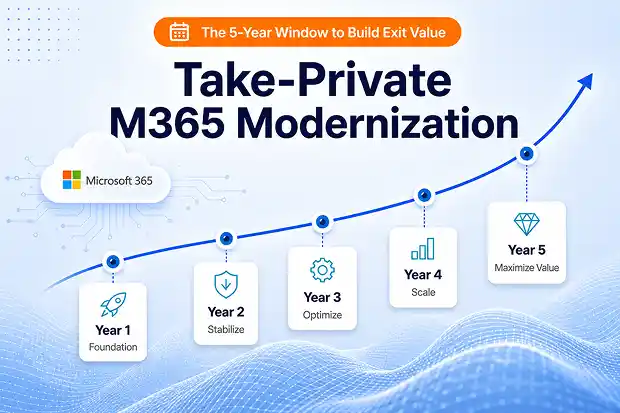
The best operators do not try to modernize everything at once. They break the work into stages that match the private equity hold period. Each year should show clear progress, measurable savings, and improving the company before the final sale.
Year | Focus | Outcome |
|---|---|---|
|
Year 1 |
Assess the current Microsoft 365 environment and deliver quick wins |
Stabilize the environment and capture early savings |
|
Year 2 |
Complete major migrations, such as Teams Phone and Microsoft Purview |
Retire legacy systems, reduce vendor costs, and lower compliance risk |
|
Year 3 |
Roll out Copilot and AI tools across the business |
Improve productivity and begin showing measurable business impact |
|
Years 4–5 |
Prepare the modernization story for exit |
Present a stronger modern-technology story in the Confidential Information Memorandum, or CIM |
The goal is simple: stabilize the environment early, complete the major migrations in the middle of the hold period, and use the final years to show how modernization has improved efficiency, reduced risk, and strengthened the company’s exit story.
Why Sponsors Are Funding M365 Modernization Directly
Private equity sponsors are no longer treating Microsoft 365 modernization as a small IT expense. In many take-private deals, they are planning for it upfront and including it in the overall value-creation budget.
The reason is straightforward: sponsors invest in projects that can improve earnings, reduce risk, or make the company more attractive at exit. M365 modernization can support all three. It can help reduce legacy technology costs, improve security and compliance, increase employee productivity, and create a stronger technology story for future buyers.
This is why M365 modernization is starting to be viewed less as routine IT maintenance and more as value-creation investment. It belongs in the same conversation as ERP upgrades, data-platform modernization, and other major transformation programs that help improve the business before exit.
Why This Matters for Service Providers
Take-private portfolio companies are a big opportunity for Microsoft 365 service providers. These companies usually have bigger projects, larger budgets, longer project timelines, and a stronger need to modernize compared to normal portfolio companies.
After a company goes private, three things normally happen together:
- The private equity sponsor wants a strong modernization story for the future exit.
- The CIO gets approved budget and leadership support.
- The investment hold period creates a fixed deadline to complete improvements.
Because of this, Microsoft 365 work becomes more than just a one-time migration project. It becomes a multi-year modernization program.
In short, M365 modernization is moving from optional IT spend to funded value-creation work. Providers that understand this shift can become strategic partners, not just implementation vendors.
The Takeaway for Operators and Sponsors
Microsoft 365 modernization should not be treated as basic IT cleanup. For take-private companies, it can be a direct part of the value-creation plan.
The firms that plan it early, fund it properly, and connect it to the exit story will be in a stronger position. They can reduce legacy costs, improve security and compliance, increase productivity, and show future buyers a cleaner, more modern technology platform.
The firms that delay this work may miss an important opportunity. What looks like back-office IT today can become lost margin, higher risk, and a weaker exit story tomorrow.