
Introduction
Microsoft Planner has quietly become the operational heartbeat of many Microsoft 365 teams. It is where your project tasks live, dependencies are tracked, and day to day execution is coordinated across departments. Every plan represents a live snapshot of how your work actually gets done, far beyond what static project documents can show.
If you lose those boards during a Microsoft 365 tenant migration, projects can stall, owners can get confused, and trust in IT can quickly erode.
That is why Microsoft Planner tenant to tenant migration matters so much. You need a reliable way to move plans, tasks, comments, and attachments between Microsoft 365 tenants without breaking the workflows your teams rely on every day.
This article explains how to migrate Microsoft Planner plans, tasks, and associated data between Microsoft 365 tenants, helping your teams continue working smoothly without disruption.
- Why You Need Microsoft Planner Tenant to Tenant Migration
- Why Microsoft Has No Native Planner Migration
- Core Challenges in Microsoft Planner Tenant to Tenant Migration
- Planner Migration Options at a Glance
- Option 1: Manual Migration with Graph API and PowerShell
- Option 2: Microsoft Planner Migration with Migration Tools
- Planner Migration During Mergers and Acquisitions
- Integrated Migration of Teams and Planner
- Step by Step Planner Tenant to Tenant Migration with Apps4.Pro
- FAQs: Microsoft Planner Tenant to Tenant Migration
Why You Need Microsoft Planner Tenant to Tenant Migration
When you migrate a Microsoft 365 tenant without Planner, your teams are suddenly without their day-to-day work boards. Those tasks, checklists, comments, and attachments are often the single source of truth for active projects that people depend on.
You are likely to face Planner tenant to tenant migration in situations such as:
- Mergers and acquisitions where multiple Microsoft 365 tenants need to be consolidated.
- Divestitures where selected business units move to a new tenant.
- Rebranding or compliance driven tenant migrations across regions.
Without a dedicated migration path, you or your teams may end up recreating plans manually or exporting partial data with scripts, which introduces risk and causes frustration.
Why Microsoft Has No Native Planner Migration
Microsoft FastTrack documentation clearly confirms that Planner is not supported for cross tenant migration. The main reason is that Planner data is spread across multiple Microsoft Graph API endpoints instead of a single exportable data store.
Here is what that means for you:
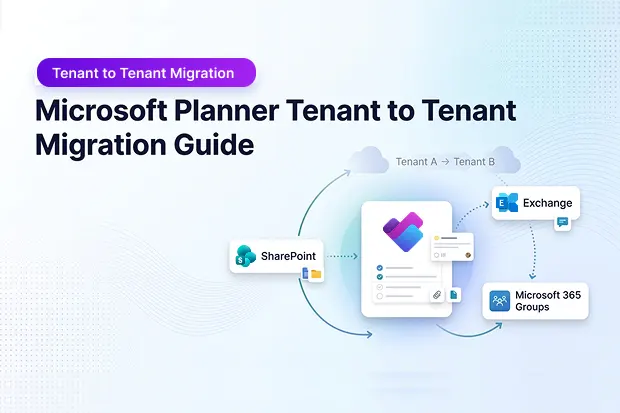
- Tasks, plans, and buckets live in the Planner API, while attachments sit in SharePoint Online.
- Comments are stored as conversations in the associated Microsoft 365 Group mailbox in Exchange Online.
- There is no single native export and import command that preserves these relationships and metadata across tenants.
The Planner PowerShell administration commands such as Set PlannerConfiguration only control tenant level settings like enabling Planner and roster plans; they do not provide any way to export or migrate Planner data between tenants. Because of this architecture limitation, Planner tenant to tenant migration becomes complex unless you use specialized tooling.
For a deeper explanation of why Microsoft has not shipped a native Planner migration path, explore our article “Why Microsoft Planner Has No Native Migration”.
Core Challenges in Microsoft Planner Tenant to Tenant Migration
Because every Planner plan is backed by an M365 Group and often connected to a Microsoft Teams channel, migration is never just about moving tasks. You need to preserve relationships between groups, plans, tasks, attachments, and comments across Microsoft 365 tenants, so users feel at home after the move.
If you rely on manual scripts or inadequate tools, you are likely to run into issues such as:
- Comments getting lost or flattened, which breaks the conversation history your teams depend on.
- Attachments becoming orphaned when SharePoint URLs are not updated to point to target locations.
- Task assignments failing if user mapping is not handled correctly between office 365 tenants.
A robust Planner migration approach needs to handle these risks end to end while respecting Microsoft Graph API throttling and error handling limits.
Planner Migration Options at a Glance
For migrating Microsoft Planner between tenants, you primarily have two choices: manual migration using Graph API and PowerShell, or leveraging third-party tools designed for this task.
Option 1: Manual Migration with Graph API and PowerShell
You might be tempted to script Planner tenant to tenant migration yourself using Microsoft Graph API and PowerShell. In this approach, you read plans and tasks from the source tenant and recreate them in the target tenant.
Conceptually, you would use:
- Graph API endpoints such as GET /planner/plans and GET /planner/tasks to read content.
- POST /planner/tasks and related calls to rebuild tasks, assignments, and buckets in the target tenant.
However, once you start, you will quickly see the limitations:
- Graph API throttling for Planner is around 120 requests per minute, which slows down large migrations.
- Comments and some metadata are not easily exportable and often need complex workarounds.
For a detailed look at what it takes to script Planner moves with Graph and PowerShell, see our deep dive on “Complete DIY Guide on How to Migrate Microsoft Planner with Graph API & PowerShell”.
Option 2: Microsoft Planner Migration with Migration Tools
Migration Tools like Apps4.Pro Migration Manager gives you a dedicated Microsoft Planner migration tool that is built to handle tenant to tenant scenarios at scale. It is designed for Microsoft 365 tenant migrations where Planner needs to move along with other relevant workloads such as Exchange online mailbox, SharePoint, and Teams.
With this specialized Planner migration solution, you can:
- Migrate Planner plans across Microsoft 365 tenants including buckets, labels, tasks, and assignments.
- Preserve comments with original author and timestamp, using either HTML consolidation or individual conversation modes.
- Move attachments while correctly updating SharePoint based file locations in the target tenant.
Because Apps4.Pro is built on top of Microsoft Graph API and M365 Groups architecture, it takes care of throttling, retries, and error handling for you.
Planner Migration Scenarios Supported by Apps4.Pro
Apps4.Pro Migration Manager supports the main Planner migration patterns you are likely to need.
You can use it to:
- Move Planner plans from one Microsoft 365 tenant to another, including standalone and Teams associated plans.
- Migrate plans into new or existing Microsoft 365 Groups or Teams during consolidation or restructuring.
- Reorganize plans inside the same tenant, moving boards between groups or teams without rebuilding them manually.
- Migrate both standard Planner and Planner Premium boards.
How Apps4.Pro Handles Core Planner Migration Scenarios
For Planner migration to feel complete to your users, the target tenant must look and behave like what they were used to in the source tenant. Apps4.Pro Migration Manager is aligned with this expectation and focuses on what users actually see inside Planner.
With Apps4.Pro, your Planner migration scope can include:
- Group creation, plan creation, plan settings, and members.
- Buckets, tasks, task titles, progress, start and due dates, descriptions, and checklists.
- Attachments, comments, user assignments, applied labels, and metadata such as created by and completed by.
For the complete scope of what gets migrated, including detailed fields and limitations, refer our documentation on Scope of Microsoft Planner Migration.
Planner Migration During Mergers and Acquisitions
During mergers and acquisitions, Planner migration often becomes one item on a long Microsoft 365 migration checklist that also relates to Exchange, SharePoint, and Teams.
Transition Service Agreement deadlines and integration milestones add pressure and make it essential for you to move workloads on time.
For Planner specifically, the risks in M&A tenant to tenant migration include:
- Critical projects losing context if comments and attachments do not move.
- Users getting confused when task assignments break due to identity changes between tenants.
- Duplicate or parallel boards across both tenants, making it unclear which plan should be treated as the source of truth.
For step by step guidance tailored to mergers and acquisitions, read the full article on “How IT Teams Move Task Data Between Tenants during Microsoft Planner Migration for Mergers and Acquisitions”.
Integrated Migration of Teams and Planner
Many of your Microsoft Planner boards probably appear as tabs in Microsoft Teams channels. Because every Team is backed by an M365 Group and each Planner plan sits in an M365 Group, you need to think about Teams and Planner together during migration.
A Teams plus Planner migration strategy works best when you:
- Treat M365 Groups as the architectural bridge between Teams, Planner, and SharePoint.
- Wish to migrate Teams and the associated Planner plans along with their tasks and metadata intact.
For more detail on this combined approach, see our Complete Teams migration with SharePoint and Planner article.
Step by Step Planner Tenant to Tenant Migration with Apps4.Pro
When planning a successful Microsoft Planner tenant to tenant migration, it is important to approach the process methodically to reduce risks and ensure data integrity.
These steps outline how Apps4.Pro Migration Manager efficiently transfers Planner plans, tasks, and metadata between Microsoft 365 tenants.
- Prepare source and target Microsoft 365 tenants with the correct permissions and licenses.
- Configure user mapping between tenants using manual mapping, auto-map, or CSV import depending on your scenario.
- Run pilot migrations, validate data fidelity, and then execute full migration waves once you are confident.
For the complete pre-requisites, configuration steps and troubleshooting, see our Microsoft Planner Tenant to Tenant Migration Guide.
FAQs: Microsoft Planner Tenant to Tenant Migration
Planner can be transferred between Microsoft 365 tenants by utilizing specialized solutions such as Apps4.Pro Migration Manager, as Microsoft does not currently offer a native migration tool for Planner.
With scripts or limited tools, you often lose:
-
Comment history and conversation context.
-
Metadata like created by or completed by.
-
Assignments and labels when user mapping are not done correctly.
A Planner focused tool greatly reduces this type of data loss.
The permissions and licenses required to perform Apps4.Pro Microsoft Planner tenant to tenant migration are as below:
- Valid Microsoft 365/Office 365 License with “Microsoft Planner” app enabled is required for Source & Target Connector Accounts.
- Valid Microsoft 365/Office 365 License with “Exchange Online” app enabled is required for Target Connector Account.
- User Administrator is required for both Source & Target Connector Accounts.
- Source Connector Account should be a Member of the Plans that you choose to migrate
Migrate Your Planner Plans Like A Pro!
If you are planning a Microsoft Planner tenant to tenant migration, Apps4.Pro Migration Manager can help you with
- Moving plans, tasks, comments, and attachments with confidence
- Adhering to FastTrack guidance, Graph API restrictions, and M365 Groups’ design principles


















 Migrate
 Manage
 Migrate Microsoft 365