
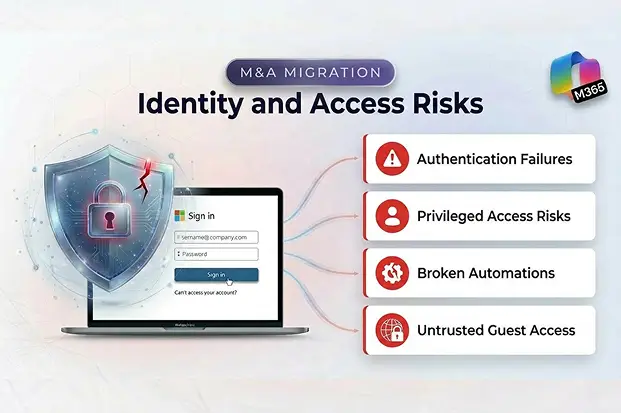
Regulators, auditors, and the board are shifting M&A scrutiny toward operational resilience and identity-driven risk, not just IT timelines. Your decisive Day 1 question is simple: Will the combined Identity and Access model withstand real users, real workloads, and real attackers when the deal goes live.
That shift changes how you should plan the integration: if identity fails, every “migrated” workload fails with it. Treat identity as the foundation not a late-stage dependency and you turn a high-risk cutover into a controlled, evidence-based transformation the rest of this blog will walk you through.
Assessing identity risk before signing?
See Secure Score as a Term-Sheet Adjuster for how identity posture can directly influence deal value and conditions.
- Identity In M&A: The Hidden Control Plane
- Why Leadership Keeps Underestimating Identity Risk
- Where Identity Breaks: Critical Failure Patterns
- Conflicting Identities And Colliding Domains
- Hybrid AD, SID History And Legacy Access
- Conditional Access Conflict And MFA Fatigue
- Guest Sprawl And Untrusted External Access
- Broken Automations: Tokens, Service Principals, Managed Identities disruptions
- Devices, Intune, And Endpoint Chaos
- From Outages To Outcomes: What Chaos Looks Like At The Top
- The M&A Identity Audit Playbook
- Apps4.Pro: An Identity-First Approach To M&A
- FAQs: What Leaders Ask About Identity In M&A
Identity In M&A: The Hidden Control Plane
Most executives still frame M&A migration as a data-copy project such as Mailboxes, SharePoint sites, Microsoft Teams, and file shares. But the success (or failure) of every one of those moves is governed upstream by identity in Entra ID and hybrid Active Directory: the control plane that decides who can access what, from where, and under which conditions.
- Hybrid AD forest trusts, managed identities, and service principals define who can talk to what, not just where the data lives.
- Token lifecycles, conditional access, and MFA policies decide whether people can log in at all after cutover.
Once you see identity as the control plane, the real risk becomes obvious: decisions that look “technical” (UPNs, tokens, policies, guests) are actually business controls. And when those controls aren’t visible in due diligence, leadership naturally underestimates both the blast radius and the effort required to stabilize Day 1.
Why Leadership Keeps Underestimating Identity Risk
The most dangerous assumption you face is the belief that this is a one-time data move instead of an identity and access redesign.
Per real world scenarios, failing to inventory service principals, managed identities, and integrated applications, can leave people locked out of HR systems and critical business processes.
- Many recent migration studies show that in Microsoft 365 M&A projects, security and compliance are now harder to manage than the actual data move itself.
- Due diligence decks routinely track user counts and mailbox sizes, but rarely include a full catalog of app registrations, OAuth flows, or cross-tenant access dependencies.
Leaders underestimate identity risk not because they ignore it, but because it rarely shows up in business language. It hides in routine exceptions – new integrations, unmanaged privileges, stale contractor access and gets dismissed as isolated IT noise instead of a repeatable control failure (a pattern that directly impacts valuation and deal protections, explored in Secure Score as a Term-Sheet Adjuster).
The goal, then, isn’t another warning – it’s a repeatable way to spot trouble early. In the next section, I’ll break down the most common identity failure patterns and the practical signals that tell you they’re already forming behind the scenes.
Where Identity Breaks: Critical Failure Patterns
These are the identity and access problems that typically surface between signing and TSA exit, and why they matter in the language your board and C-suite understand.
Conflicting Identities And Colliding Domains
On paper, “20,000 users in each tenant” looks straightforward; in practice, you hit duplicate objects, conflicting UPNs, and domains that can only exist in one tenant at a time.
The outcome is authentication failures, broken SSO, and email delivery issues at the precise moment leadership expects a seamless Day 1.
- Business impact: Users locked out, stalled sales cycles, missed customer communications, and executive escalations within the first hour of cutover.
- Compliance impact: Failed communications around regulatory filings or customer notices can be interpreted as control weakness in audits.
Hybrid AD, SID History And Legacy Access
In hybrid environments, new Entra ID objects created during cross-tenant migrations do not automatically retain SID history needed for legacy file servers and line-of-business apps.
Without proper AD forest trusts and SID History migration, people suddenly lose access to file shares, printers, and older ERP or manufacturing systems.
- Business impact: Plant operations, finance closes, or warehouse processes stall, even though “the data is already migrated.”
- Workforce impact: Local IT teams fire-fight access issues for days, while business leaders see it as a failure of central IT planning under your watch.
Conditional Access Conflict And MFA Fatigue
Conditional Access policies and MFA registrations are tenant-bound; they do not automatically transfer when identities move.
In one real-world case, over 2,000 users were locked out on Day 1 because CA policies were not documented and rebuilt correctly in the target tenant.
- Business impact: Complete productivity stoppage and a helpdesk surge at 5–10x normal volume as people re-register MFA and troubleshoot sign-ins.
- Executive impact: Your security leadership is asked why there was no “CA dry run” and why basic login hygiene was not validated before cutover.
Guest Sprawl And Untrusted External Access
Both tenants usually carry years of B2B/B2C guest accounts with unclear permission inheritance and overlapping partner relationships.
If you migrate without a pre-deal cleanup, you bring stale, over-permissioned guests into the combined environment.
- Security impact: Excessive access rights, hard-to-explain audit findings, and elevated risk of external accounts persisting longer than contracts.
- Business impact: Partner portals and shared collaboration workspaces either stop working or stay open far beyond what legal and procurement expect.
Broken Automations: Tokens, Service Principals, Managed Identities disruptions
Cached tokens, app registrations, service principals, and managed identities are all tenant-specific.
When you cut over, OAuth flows can start failing, background jobs stop running, and integrated systems behave unpredictably if dependencies were not mapped.
- Business impact: HR and finance processes fail, customer integrations go dark, and issues may only surface days or weeks after cutover.
- Executive impact: Technology leadership appears reactive and unprepared, eroding trust right when post-deal integration needs strong sponsorship.
Devices, Intune, And Endpoint Chaos
Intune-managed devices often require re-enrolment in the target tenant, and app profiles must be rebuilt.
If this is not piloted and sequenced, you create rolling outages as users lose access to corporate resources on their primary devices.
- Business impact: Field and remote workers are hit hardest, with limited local support and high dependency on their devices.
- Operational impact: Your IT operations team is pulled into lengthy one-to-one remediation, delaying other critical integration work.
Individually, each pattern looks like an IT issue you can patch. Together, they create a predictable chain reaction: Authentication failures become operational downtime, downtime becomes missed commitments, and missed commitments become board-level questions about control and resilience.
From Outages To Outcomes: What Chaos Looks Like At The Top
Identity and access chaos in an M&A migration shows up in board and regulator language, not just in your incident queue.
Regulatory and audit risk:
- Inconsistent access records make it hard to prove who had access to what during the transition
- Orphaned guests and excessive permissions trigger audit findings
Executive escalation and reputation:
- Locking out hundreds or thousands of users becomes a headline in internal town halls
- The acquiring brand is blamed for “botching IT,” even when root causes sit in historical debt
Workforce disruption:
- Large parts of the workforce spend the first week post-cutover in password resets, MFA fixes, and access requests
- Operational teams fall back to manual workarounds, driving error rates and frustration
Deal value impact:
- Synergy timelines slip because integration milestones depend on stable identity foundations
- Additional tooling, consultants, and extended TSA periods quietly erode the financial case of the deal you are accountable for delivering
The good news is that this chaos is not random – it’s diagnosable. An identity audit gives you a clear, defensible picture of what must be remediated before Day 1, what can be staged through TSA, and what needs ongoing governance after cutover.
The M&A Identity Audit Playbook
This identity audit needs to happen during due diligence, not as an afterthought before Day 1. Use this checklist directly in your next leadership or M&A integration meeting.
Identity inventory and mapping:
- Catalogue all Entra ID tenants, domains, UPN patterns, and overlapping namespaces
- Identify duplicate identities, conflicting UPNs, and cross-tenant B2B relationships
Hybrid and legacy access:
- Map on-prem AD forests, trusts, and SID history requirements
- Identify all legacy apps and file shares that rely on Windows integrated auth
Policy and security posture:
- Export and document Conditional Access policies and MFA configurations from each tenant
- Compare security baselines and identify conflicts that could lock out users
Automation, apps, and integrations:
- Inventory app registrations, service principals, managed identities, and OAuth configurations
- Tag “business critical” automations that affect HR, finance, and customer-facing systems
Devices and endpoints:
- Assess Intune enrolment patterns and required device re-enrolment steps
- Plan pilot waves to validate device and app behavior before broad rollout
Governance, ownership, and RACI:
- Assign clear ownership for identity risk across M&A, security, and IT operations
- Define escalation paths and war-room conditions before cutover
If you’re running this audit manually, speed and completeness become the constraint – especially around non-human identities and hidden app dependencies. That’s where an identity-first toolset can help you inventory faster, surface risks earlier, and walk into steering committees with evidence instead of assumptions.
Apps4.Pro: An Identity-First Approach To M&A
Apps4.Pro approaches M&A migrations from an identity-first perspective, treating data movement as only one component of the larger control-plane problem.
Keyways Apps4.Pro can help you:
- Pulls Inventory across Entra ID and Microsoft 365 so you can expose risks early in the deal cycle.
- Automated discovery of users, groups, and guest accounts across tenants.
With this, you gain: Evidence-based conversations with leadership about identity risk and mitigation.
Start with an early Identity Risk Assessment
Apps4.Pro can generate a comprehensive Microsoft 365 Tenant Inventory to uncover identity conflicts and access risks before your migration begins – ideally, before the deal closes.
Access our self-service PowerShell Scripts to quickly generate a Tenant-level Inventory
Want to quantify identity risk before it impacts your deal? Explore Secure Score as a Term-Sheet Adjuster to understand how security posture can shift valuation and terms.
FAQs: What Leaders Ask About Identity In M&A
That timing lets you align deal assumptions, integration plans, and budgets with real identity complexity.
Add guest-account cleanup progress and the share of critical apps that passed end-to-end access testing.

















 Migrate
 Manage
 Migrate Microsoft 365