
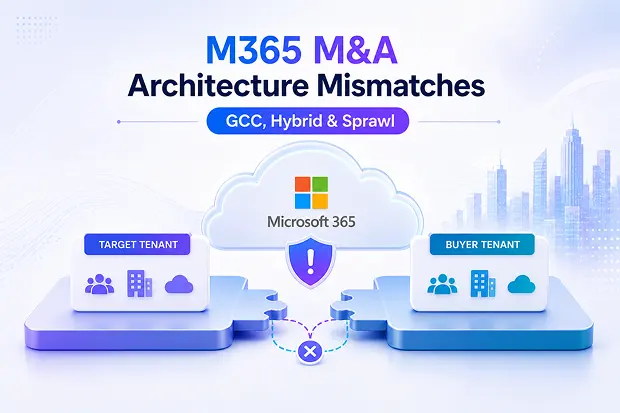
Even a well-run M&A integration can fail on cutover day if the two Microsoft 365 (M365) tenants were never built to work together. We call this an architecture mismatch. It is not a bug. It is not a setup mistake. It is not a missing license. It is a difference in the shape of the two tenants, and once the deal is signed, no amount of project management will fix it.
The good news is that these mismatches are visible before you sign. Your job in DD is to find them, put a price on them, and flag them to the deal team. If you miss them, they come back as migration blockers, extended timelines, or, in the worst cases, deals that cannot be technically completed at all.
This blog covers the five architecture mismatches that cause the most trouble:
- GCC and GCC-High (US government) tenants
- Education (EDU) tenants
- Multi-Geo tenants
- Hybrid Exchange (on-premises plus cloud)
- Non-production tenant sprawl
- Architecture is about the tenant’s shape, not its contents
- GCC and GCC-High tenants block commercial migration tools
- EDU tenants come with student-data rules a normal buyer cannot ignore
- Multi-Geo Tenants Are Like Multiple Tenants in One
- Hybrid Exchange quietly stretches the migration by weeks
- Non-production tenants raise audit risk and leave behind unused licenses
- Pre-signing checklist
- How this blog fits into the pre-deal series
Architecture is about the tenant’s shape, not its contents
Most M365 due-diligence work looks at what is inside the tenant, hidden Power Platform flows, undisclosed legal holds, weak Secure Score, wasted licenses. Architecture mismatches are different. They are about the tenant itself: which Microsoft cloud it lives in, which regions it spans, how identity is set up. The shape of the tenant decides what is even possible.
Microsoft keeps tenants strictly separated. There are hard walls between commercial and US government clouds, between Education and commercial tenants, and between hybrid and cloud-only Exchange setups. Standard cross-tenant migration paths do not cross these walls.
This blog sits in the second wave of our pre-deal series. The audience is smaller, but for the buyers it applies to, missing one of these mismatches is a board-level problem.
GCC and GCC-High tenants block commercial migration tools
If the target uses GCC (Government Community Cloud), GCC-High, or DoD (Department of Defense Cloud), your usual migration tools will not work. These clouds run as separate tenancies with separate compliance and tenancy rules, and there is no built-in way to move data from a normal commercial tenant into a GCC-High target.
The bigger problem is what comes with the deal. If the target is in the defense industrial base, certifications and regulated revenue are tied to the specific cloud and configuration. Mishandle the migration and the target loses the certification – and with it, the regulated revenue you paid for.
What to do during DD:
- Ask the cloud question in writing during the first round of DD. Do not guess from the domain or SKU list.
- If the answer is GCC, GCC-High, or DoD, plan a specialized migration with cleared people and FedRAMP-authorized tooling. Budget specialist rates.
- Bring compliance counsel in during DD, not after.
- Flag the cloud type as a pre-signing finding for the deal team.
EDU tenants come with student-data rules a normal buyer cannot ignore
You can usually spot Education tenants by their A1, A3, or A5 licenses and edu domain. Microsoft FastTrack does not support EDU cross-tenant migrations, and Microsoft’s multi-tenant organization (MTO) features explicitly exclude scenarios involving student data.
In ed-tech and school-district deals, mishandled student data hits the news as an academic problem before it ever becomes a technical one. Find out the tenant is EDU before you set the price.
DD steps:
- Confirm EDU status early.
- Plan a specialized education migration approach using third-party tooling pre-qualified for student data.
Bring in education data-privacy counsel during DD.
Multi-Geo Tenants Are Like Multiple Tenants in One
Microsoft 365 multi-Geo allows organizations to store user data in different regions to meet data residency requirements.
But during migration, this setup can behave like several smaller tenants instead of one. Each region (geo) can have its own limits, rules, admin access points, and data requirements.
Common Problems
These issues usually come up:
- The target tenant uses regions that the buyer doesn’t have licenses for.
- Users’ Preferred Data Location (PDL) doesn’t match the setup in the buyer’s tenant.
- The target has data residency commitments to customers that the buyer can’t meet without adding new regions.
What to Check (Due Diligence)
Ask for details about the target’s multi-Geo setup, including:
- Primary region
- Satellite regions
- PDL distribution across users
Then compare this with the buyer’s licensing and available regions.
If there are differences, treat them as important. They can impact migration effort, increase costs, and create risks around data residency and customer commitments.
Hybrid Exchange quietly stretches the migration by weeks
If the target still runs on-premises Exchange synced with Exchange Online, the real complexity may not show up until cutover.
Hybrid Exchange environments depend on several systems staying aligned: on-premises Active Directory, directory sync, Exchange Online, and sometimes a federation provider. When attributes do not match, or when old exceptions were never documented, the issues can sit quietly until mailboxes begin moving.
This pattern is common in mid-market and enterprise deals. Smaller businesses are more often cloud-only.
DD Steps
Start by confirming whether the target has on-premises Exchange.
If it does, request:
- Server inventory, including versions, roles, and Cumulative Update levels,
- Directory-sync configuration export,
- Active Directory Forest and domain diagram,
- Recent sync-error history.
How to Plan Around It
Where it makes sense, plan a two-step migration: first move on-premises mailboxes into Exchange Online inside the source tenant, then complete the cross-tenant move.
Also, budget for specialist Hybrid Exchange support. These environments often require premium consulting time, especially when sync errors, legacy attributes, or undocumented exceptions are involved.
For deeply hybrid environments, evaluate whether the target can be moved to cloud-only before cutover. If that is not feasible, expect significant hybrid-identity and Exchange specialist effort.
Non-production tenants raise audit risk and leave behind unused licenses
Mature companies almost never run just one tenant. They run a production tenant plus dev, test, staging, training, demo, sandbox, and tenants left over from old acquisitions that no one ever shut down. Each one is a separate licensing line and a separate compliance area.
Sellers rarely volunteer non-production tenants in DD because they do not show up in the headline production numbers in the data room. The result is stranded license commitments and inflated audit exposure once Microsoft sees the merged environment.
DD steps:
- Ask for a list of every non-production tenant as a separate data-room artifact.
- Reconcile it against the target’s licensing records.
- Price decommissioning or consolidation into the integration budget – not the later optimization phase.
Pre-signing checklist
Finding | DD artifact to request |
|---|---|
|
GCC, GCC-High, or DoD tenancy |
Cloud type confirmation in writing |
|
EDU tenancy |
A1/A3/A5 SKU list, .edu domain confirmation |
|
Multi-Geo configuration |
Primary region, satellite regions, PDL distribution per user |
|
Hybrid Exchange |
Exchange server inventory, directory-sync config export, AD forest and domain diagram, recent sync-error history |
|
Non-production tenant sprawl |
Tenant-by-tenant inventory reconciled to licensing records |
How this blog fits into the pre-deal series
This blog is narrower than the main The M365 Pre-Deal Due Diligence Problem and the higher-priority pieces on legal holds, Secure Score, and cost estimation. It is for defense and defense-contractor buyers, mid-market deal teams taking on hybrid technical debt, and global enterprises dealing with multi-Geo.
For what to do after close: the EDU migration piece, Multi-Geo Tenant Migration M&A, A CIO Playbook for Microsoft M&A Exchange Online Migration.
One line to leave with the deal team: an architecture mismatch found after signing is a migration blocker. The same mismatch found in DD is just a finding the deal team can plan around.
















 Migrate
 Manage
 Migrate Microsoft 365