
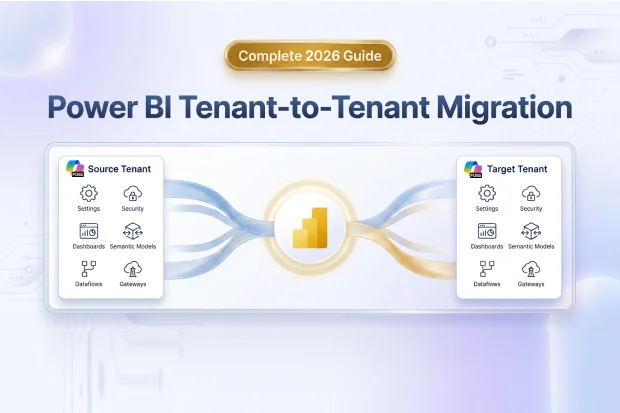
Power BI tenant to tenant migration is the process of moving workspaces, reports, semantic models, dashboards, dataflows, gateways, and security settings from one Microsoft 365 tenant to another. Organizations typically require this during mergers, divestitures, tenant consolidation, rebranding, or regional restructuring.
The challenge is: Microsoft does not provide a native end-to-end Power BI cross-tenant migration tool. There is no “move workspace” option.
Instead, teams must rebuild large parts of the environment in the target tenant, reconnect data sources, restore security, reconfigure gateways, and validate reports after cutover.
At scale, this turns Power BI migration into a high-risk reconstruction project, not a simple data transfer. Understanding why Power BI migration is difficult starts with how Power BI objects are tied to the source tenant.
- Why Microsoft Has No Native Power BI Migration Tool
- What Gets Migrated (and What Doesn’t)
- The Risk of Manual Migration
- Power BI Gateway Migration
- Migrating Datasets & Semantic Models
- Row-Level Security During Migration
- Power BI Migration During M&A
- Manual Migration via REST API
- A Smarter, Automated Solution with Apps4.Pro
- Steps to Migrate Power BI from One Tenant to Another with Apps4.Pro:
- Need a Faster Way to Migrate Power BI?
- Frequently Asked Questions
Why Microsoft Has No Native Power BI Migration Tool
Power BI objects are tightly bound to a specific Microsoft Entra ID tenant. Workspaces, semantic models, gateways, and security assignments are not portable across tenants.
Because of this architecture, Microsoft does not offer a single API or feature that can move a workspace across tenants in one step.
In practice, migration becomes a multi-step rebuild, including:
- workspace recreation
- report export/import
- semantic model rebinding
- gateway reconfiguration
- credential restoration
- RLS reassignment
- permission mapping
This approach may work for a few reports. But at enterprise scale, it leads to:
- increased failure points
- longer migration timelines
- higher post-migration cleanup effort
What Gets Migrated (and What Doesn’t)
A cross-tenant Power BI migration can move core content into the target tenant. But several critical dependencies do not transfer automatically.
What typically moves
- reports
- semantic models
- dashboards
- dataflows
- workspace structure
What does NOT transfer cleanly
- gateway registrations
- stored credentials
- refresh schedules
- object GUIDs
- usage history
This gap is critical. A report may open successfully after migration but still fail in production due to broken connections or missing credentials.
Row-Level Security (RLS) memberships also do not move in manual migrations because they are stored in the Power BI service, not inside the PBIX file. That means teams must manually rebuild user and group assignments after cutover.
Apps4.Pro Migration Manager reduces this effort by restoring RLS memberships and remapping permissions and gateway data sources during migration.
For the complete verified scope, see the full Apps4.Pro Power BI Migration Support Guide.
The Risk of Manual Migration
The manual process is time-consuming and error-prone, and it often leads to broken links, lost access, and frustrated stakeholders. The core challenges repeat in every project:
Key risks include:
- Planning complexity at scale -Recreating even a handful of workspaces manually can require a large number of separate actions, and each one creates another opportunity for error.
- Gateway reconfiguration – Gateway registrations, data source definitions, stored credentials, and semantic model bindings are tenant-bound and do not move with workspace content.
- Dataflow migration gaps – There is no native end-to-end dataflow export/import path, so teams often have to recreate dataflows manually in the target tenant.
- Silent semantic model failures – Import-mode reports can continue showing cached data even when credentials are broken, which hides the problem until users notice stale data.
- Incomplete RLS migration – Exporting a PBIX file carries role definitions and DAX filters, but not role memberships, so users and groups must be reassigned in the destination tenant.
- API rate limits – Power BI admin and scanner API limits can slow discovery and disrupt poorly optimized migration scripts.
Together, these issues can turn a seemingly manageable migration into a multi-week project with significant operational risk.
Power BI Gateway Migration
Microsoft Power BI gateway migration is a reconfiguration task, not a data transfer task. The on-premises gateway server usually remains in place, but its registration, data source definitions, stored credentials, and semantic model bindings must be rebuilt in the target Microsoft 365 tenant.
The rebuild typically follows seven steps: inventory the source environment, define the target topology, re-register each gateway in the target tenant, recreate data sources, re-enter credentials, rebind migrated semantic models, and recreate refresh schedules. For a full step-by-step walkthrough, see the Power BI Gateway Migration Guide.
Migrating Datasets & Semantic Models
In November 2023, Microsoft renamed datasets as semantic models. The terminology changed, but the migration challenges did not. Semantic models remain one of the most fragile parts of a Power BI tenant to tenant migration.
When a semantic model moves across tenants, key dependencies do not move with it. GUIDs change, data source credentials are lost, refresh schedules disappear, and shared semantic model references must be rebound. As a result, a report that appears to work may still be showing stale data.
For a deeper look at semantic model migration, see Migrating Power BI Semantic Models (Dataset).
Row-Level Security During Migration
Row-Level Security (RLS) in Power BI has two parts. The role definition lives inside the semantic model and can move with a PBIX file. The role membership, including users and Microsoft Entra ID security groups, lives in the Power BI service and does not move with it.
As a result, a migrated PBIX file may contain the original RLS logic but still require all memberships to be recreated in the target tenant. Until that happens, affected users may see no data.
Object-Level Security (OLS) metadata can also move with the PBIX, but enforcement depends on the target workspace running on the correct Premium, PPU, or Fabric capacity.
For more detail, see Power BI RLS in Migration.
Power BI Migration During M&A
In a merger or acquisition, Power BI migration must fit within tight TSA (Transition Services Agreement) timelines while key dashboards remain available. This makes it a very different challenge from a standard platform upgrade.
The biggest risks usually include GUID changes that break embedded reports, SharePoint and OneDrive URL changes that disrupt semantic model connections, gateway rebinding issues, and security-model drift during tenant consolidation.
For the full M&A playbook, see Power BI Migration for M&A IT Teams.
Manual Migration via REST API
For teams that want to build their own migration framework, the Power BI REST API can support a manual multi-step workflow. In most cases, that includes inventorying the source tenant, creating target workspaces, assigning capacity, exporting reports as PBIX files, importing them into the target tenant, rebuilding semantic model parameters and credentials, binding models to target gateways, restoring Row-Level Security, reapplying permissions, and validating the result with test refreshes.
The trade-off is that the migration logic becomes your responsibility. That includes authentication design, token handling, retry logic for HTTP 429 throttling, and state persistence so a failure late in the run does not force a full restart.
The REST API also has hard limitations. It cannot export semantic models that use incremental refresh, does not migrate paginated (RDL) reports through the same path, does not provide a native dataflow export/import API, and cannot preserve refresh history, usage metrics, deployment pipelines, or certified and promoted endorsements.
In a mid-size enterprise, those gaps can affect a meaningful share of the Power BI estate and often drive post-migration cleanup work. For the full walkthrough, see Power BI Migration via REST API: Manual Framework vs Automation.
A Smarter, Automated Solution with Apps4.Pro
Apps4.Pro Migration Manager simplifies Power BI tenant to tenant migration by replacing a long manual REST API workflow with a more structured, admin-led process. Instead of stitching together scripts, exports, imports, rebinding steps, and exception handling, administrators can connect the source and target tenants, select workspaces, map gateways, and run the migration through a more repeatable workflow.
Apps4.Pro is designed to reduce manual effort across the most difficult parts of the project, including semantic model rebinding, Row-Level Security mapping, dataflow handling, paginated reports, incremental refresh scenarios, and rate-limit-aware execution.
Steps to Migrate Power BI from One Tenant to Another with Apps4.Pro:
Follow these five steps with Apps4.Pro Migration Manager for a smooth Power BI cross tenant migration:
- Download and install the Power BI migration tool
- Configure source and target Microsoft 365 tenants
- Map users and workspaces to corresponding target entities
- Select resources (workspaces, reports, datasets, dataflows, gateways) and click Migrate
- Monitor the migration to confirm successful transfer
Need a Faster Way to Migrate Power BI?
If you need to migrate Power BI across Microsoft 365 tenants without rebuilding everything manually, Apps4.Pro Migration Manager helps automate workspace migration, gateway mapping, RLS restoration, and other high-effort parts of the project.
That makes it easier to reduce migration risk, shorten timelines, and preserve reporting continuity during cutover.

















 Migrate
 Manage
 Migrate Microsoft 365