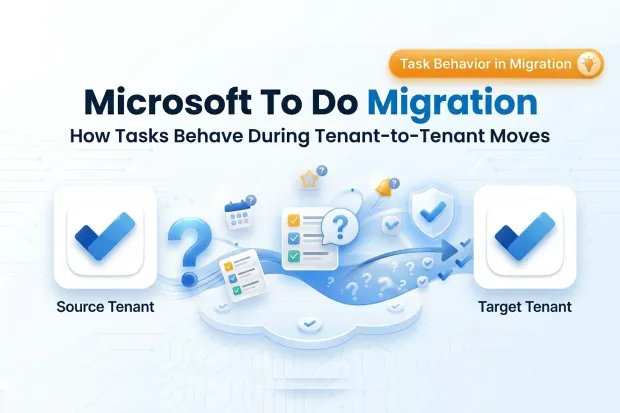
Microsoft To Do probably feels like a personal space where you quietly keep your daily tasks under control. Behind the scenes though, it is wired directly into your Exchange Online Mailbox, which makes it very important when you move to a new tenant.
If you are planning a tenant to tenant migration and you rely on Microsoft To Do, you deserve a clear picture of what happens to your tasks, what stays the same, and what will feel different.
For a comprehensive understanding of how To Do Tasks and other mailbox components integrate into a wider strategic framework, refer to Apps4.Pro’s Tenant-to-Tenant Exchange Online Mailbox Migration Tool article, which details practical migration approaches and addresses key challenges.
Before you assume a migration is where a tool simply “picks up” your To Do tasks and drops them into a new tenant, it is better to understand what To Do is actually saving, and where that information really lives.
- How Microsoft To Do Really Stores Your Tasks
- Which Microsoft To Do Task Elements Survive The Move
- The Invisible Gaps: What Does Not Survive Migration
- Rethinking Migration As Your Personal Experience
- How Apps4.Pro Supports Your To Do Journey
- Practical Playbook You Can Follow
- For admins: Key Limitations To Call Out
- FAQs: Microsoft To Do Migration During Tenant Moves
How Microsoft To Do Really Stores Your Tasks
Microsoft To Do does not store tasks inside the app itself. All of your To Do tasks are stored as Outlook tasks on Exchange Online servers in your Microsoft 365 mailbox.
Because of this tight integration:
- The same task data is shown in both Microsoft To Do and Outlook Tasks when you sign in with the same account
- Any change you make in To Do is written back to the Exchange task item, and any change in Outlook Tasks is reflected in To Do
This means that from a migration point of view, Microsoft To Do is essentially a client on top of Exchange tasks. When your Exchange Online mailbox is migrated between tenants, the underlying task data that powers To Do also travels along with that mailbox.
If you are relying on tasks to stay on track during a tenant change, peace of mind comes from knowing which details typically make the trip and which ones may need a quick backup plan.
Which Microsoft To Do Task Elements Survive The Move
Let us start with the good part. Because your To Do tasks live in your Exchange mailbox, most of the information you care about follows your mailbox to the new tenant.
During Microsoft To Do migration across tenants, you can reasonably expect these things to move with you:
- Task titles and the full description or notes you typed in the task body
- Status values such as not started, in progress, and completed
- Start dates, due dates, and reminders that you set either in Outlook or directly in To Do
- Recurring task patterns, because recurrence is a core part of the Exchange task item
- Mailbox categories and colour labels that synchronize with To Do
- Attachments that you added to tasks(stored as part of the task item itself)
Apps4.Pro Migration Manager is designed to migrate your mailbox level components, including Tasks, when it moves data between tenants. So, if your admin has configured Tasks in the migration plan, your essential To Do task data will be part of that journey.
In simple terms, the backbone of your task life stays intact. Your core tasks, dates, reminders, categories, and attached files should be there waiting for you in the new tenant.
While much of your essential task data will successfully transfer to the new tenant, it is important to note that some elements may not make the journey and could be missing after Mailbox migration.
The Invisible Gaps: What Does Not Survive Migration
Some of the Microsoft To Do features you use daily are not stored as simple fields on Exchange tasks, so they do not behave like normal mailbox data when you migrate.
You will probably feel the impact most in three areas.
Steps inside a task
If you love breaking a task into smaller steps, you are using a feature that lives primarily in the To Do app layer. Those steps are not exposed as separate tasks inside the mailbox that a migration tool can reliably move and rebuild.
That means during To Do tasks tenant migration:
- Even if some details of the steps travel inside the task, Microsoft does not document steps as a cross tenant migratable field, so you should plan as if you may need to recreate or recheck complex step checklists after mailbox migrations.
- In some cases, you might see only the parent task text and feel like the detailed breakdown has gone missing.
If you depend on steps to manage complex work, this is one of the biggest behavioural changes you will notice after cutover.
Custom task ordering inside lists
You might have lists where you have carefully dragged tasks into the perfect order for your workflow. That order looks and feels important, but it is not stored as a simple property on the Exchange task that migration tools can preserve.
After migration, you can expect that:
- Though your tasks are still in the list, the custom order you created will not be carried over
- The list will usually fall back to a standard sort, such as due date or importance
If you prefer things in a specific order, consider reorganizing your key lists in the new tenant.
List sharing and permissions
Shared lists in Microsoft To Do let you invite other people to collaborate on a specific list using an invitation link or share option in the app. They control who can see and edit that list, but this sharing is handled entirely by the To Do service and not documented as a tenant to tenant migratable setting.
When your mailbox moves to a new tenant:
- The sharing links and membership of those To Do shared lists are not preserved across tenants.
- You should plan to re-share important lists in the target tenant and re-invite collaborators so they regain access and can continue working with you.
My Day view
My Day is often the heart of daily planning in Microsoft To Do. It is a clutter free view that shows tasks you want to focus on today – including tasks that are due today and tasks you manually add.
Important details about My Day that matter for Microsoft To Do migration:
- My Day clears itself every night and repopulates with tasks due today plus anything you add for that day
- It is a dynamic view, not a separate long-term list that lives on the server
When your mailbox moves to a new tenant:
- The underlying tasks that can appear in My Day move with the mailbox
- The specific tasks you put into My Day on specific days does not move
- Your new tenant will start with a fresh My Day that rebuilds based on what is due today and what you choose to add
So, the underlying tasks are still there, but your historic My Day setups will not follow you. You get a clean slate for daily focus, which can be frustrating or refreshing depending on how you look at it 😊
A smooth migration is not just about data transfer, it is about you feeling productive again quickly. A little perspective now can save a lot of second guessing later.
Rethinking Migration As Your Personal Experience
Microsoft Mailbox To Do Migration can get tricky and technical very quickly. To make it easier for yourself, try to pause and focus on what is important for your own needs and experience.
Thinking about Microsoft To Do migration as your own journey helps you prepare emotionally and practically.
How you might be using To Do right now
You might recognize yourself in one or more of these patterns:
- You live in Outlook and only check To Do occasionally when things get busy
- You rely on To Do and especially My Day as your primary planning space every morning
- You juggle tasks in To Do, Planner, and Teams and you like seeing everything in one place
Each pattern reacts differently in To Do tasks tenant migration. If My Day and steps are key parts of how you work, you’ll notice this change much more than if you’re just focused on finding your tasks somewhere in Outlook.
Where the real friction usually shows up
From a human point of view, friction often comes from:
- Opening To Do after migration and feeling like your lists look similar but somehow “off”
- Not immediately understanding why a trusted daily ritual in My Day no longer looks like yesterday
- Realizing that your carefully curated order inside a list has reset and needs attention
Knowing this in advance lets you treat the first few days after migration as a time to rebuild your setup rather than a shocking surprise.
Understanding how Apps4.Pro supports your Microsoft To Do migration behind the scenes gives you confidence in the process, allowing you to focus on fine-tuning your task routines and making meaningful improvements after migration.
How Apps4.Pro Supports Your To Do Journey
Apps4.Pro Migration Manager focuses mainly on Exchange Online mailbox migration, which is where your tasks really live. You might never touch the tool yourself, but it is helpful to know what it is doing for you behind the scenes.
What the migration tool is actually doing for your tasks
When your admin uses Apps4.Pro for Microsoft To Do migration as part of the wider mailbox move, the tool is able to:
- Include Tasks alongside email, calendar, contacts, folders, and rules in the migration scope, so Microsoft To Do backed tasks are part of the same move.
- Handle different mailbox types such as user mailboxes, shared mailboxes, group mailboxes, archives, and public folders, wherever tasks live.
- Capture the key Exchange task properties that Microsoft To Do relies on (titles, notes, status, dates, recurrence, categories, and attachments), so your core task data is preserved in the new tenant.
- Rerun a migration for the same mailbox to capture incremental changes, which helps bring over new or updated tasks that you created during the coexistence period.
For you, this means the foundation is solid. Your task data has a structured path from the old tenant to the new one. Once that foundation is in place, the remaining work is mostly about how you want to reorganize your own lists and routines after cutover.
A Smarter Way to Migrate Exchange Mailboxes
Apps4.Pro helps simplify Exchange Online Mailbox migration projects so IT teams can move your mailboxes with greater ease and efficiency.
See How It Works
Even if your data transfers smoothly, some things can feel disorganized without a clear plan. Taking a few deliberate steps helps you quickly regain control and minimize cleanup after migration.
Practical Playbook You Can Follow
To make To Do tasks tenant migration easier on yourself, it helps to take a few simple steps before and after the move. These do not require deep technical knowledge, just a bit of awareness and a few minutes of focus.
Before Migration
You can do a light clean up and backup of what matters most:
- Look at your most important tasks that have long step lists and consider copying the key steps into the main description so the intent travels with the task
- Capture screenshots of your most important lists and your typical My Day layout so you can recreate them faster after migration
- Note any task sequences where the custom order is critical to you, for example onboarding checklists or weekly routines, so you can rebuild that order later
- Note down the collaborators of the important lists
- Use this chance to declutter by archiving or simplifying outdated or stressful lists.
Think of this as packing a small personal carry-on for your digital move. You are taking along a few things that will make the new environment feel familiar more quickly.
After Migration
Once you are in the new tenant, give yourself permission to spend a little time settling in:
- Open Microsoft To Do and Outlook and confirm that your key tasks, dates, and attachments are present
- Recreate your custom task ordering for your most important lists and pin them or favourite them so they are always easy to reach
- Re-invite collaborators of the important lists so they regain access and can continue working with you
- Spend a few minutes each morning for the first week rebuilding your My Day view based on what is due today and what truly matters that day
For admins: Key Limitations To Call Out
If you are designing or running the tenant to tenant migration, there are a few things worth stating explicitly in your runbook and user communications:
- There is no dedicated “Microsoft To Do migration” pipeline, only Exchange mailbox (Tasks) migration.
- To Do behaviours like steps, custom ordering, and past My Day choices are app controlled and non-migratable settings.
- Tools such as Apps4.Pro move task items, but the To Do app decides how to rebuild views and My Day in the new tenant.
- Behaviour may vary over time as Microsoft updates To Do, so always validate with a pilot and real user testing before broad rollout.
FAQs: Microsoft To Do Migration During Tenant Moves
- Task names and notes
- Status (not started, in progress, completed)
- Start dates, due dates, and reminders
- Recurring patterns
- Categories and colour tags
- File attachments on tasks
- Steps part of Tasks
- Your manual list ordering
- List sharing and permissions
- Past My Day selections

















 Migrate
 Manage
 Migrate Microsoft 365