
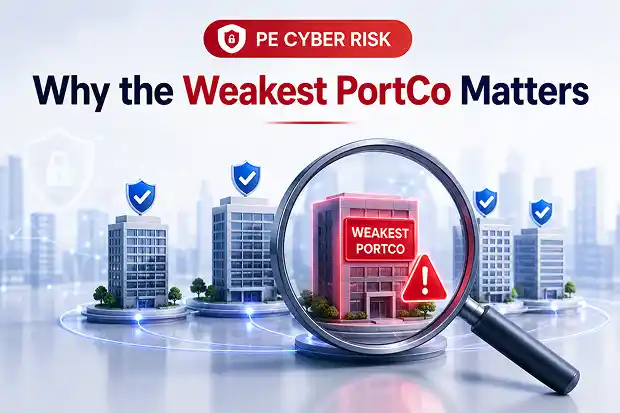
For years, Private Equity firm firms focused heavily on operational efficiency, EBITDA growth, and transformation initiatives across portfolio companies. During that process, Microsoft 365 environments often evolved independently inside each PortCo, shaped by local IT decisions, varying governance maturity, and inconsistent security investment.
The result is a growing problem many PE firms are only now beginning to recognize.
Across the portfolio, Microsoft 365 environments have quietly accumulated fragmented governance, inconsistent security controls, dormant access risks, and operational exposure that rarely becomes visible until a breach, audit, insurance review, or transaction due diligence process forces attention onto it.
And because cyber risk no longer remains isolated to individual companies, the consequences increasingly extend beyond a single PortCo.
A security incident at one portfolio company can affect:
- investor confidence,
- cyber insurance posture,
- acquisition timelines,
- enterprise reputation,
- and operational credibility across the broader PE platform.
This is fundamentally changing how Operating Partners, Group CIOs, and fund-level CISOs think about Microsoft 365 governance.
The conversation is no longer:
“Is this individual company secure?”
The real question has become:
“Can the PE platform confidently defend the security posture of the portfolio as a whole?”
Because ultimately, the portfolio’s cyber posture is defined by its weakest PortCo.
- Microsoft 365 Has Become a Portfolio-Wide Operational Risk Surface
- Why PE Firms Are Introducing Mandatory Microsoft 365 Security Baselines
- The Rise of the Fund-Level CISO
- The Silent Growth of Microsoft 365 Security Debt
- Why Security Debt Becomes Expensive During Exit
- Why Operating Partners Are Increasingly Driving Technology Decisions
- Benchmarking Is Becoming a Core Governance Discipline
- Cybersecurity Is Becoming a Portfolio Value-Creation Discipline
Microsoft 365 Has Become a Portfolio-Wide Operational Risk Surface
Modern businesses rely heavily on Microsoft 365 for communication, collaboration, identity management, document storage, and day-to-day business operations. Email systems, Teams collaboration, SharePoint environments, administrator permissions, compliance policies, and sensitive business information all sit inside the Microsoft 365 ecosystem.
As a result, Microsoft 365 is no longer simply a productivity platform. It has become one of the most important operational and cybersecurity surfaces inside the enterprise.
The challenge for PE firms is that portfolio companies rarely operate with the same level of Microsoft 365 governance maturity.
One PortCo may have:
- mature identity governance,
- strong access controls,
- structured retention policies,
- and well-managed administrator oversight.
Another may still operate with:
- outdated authentication methods,
- excessive administrator access,
- dormant user accounts,
- unmanaged third-party applications,
- or years of accumulated governance exceptions.
This inconsistency is not unusual. Portfolio companies are acquired from different sellers, at different stages of operational maturity, and under very different business conditions. Some companies may already operate within regulated industries with strong compliance expectations, while others may have historically invested very little in cybersecurity modernization.
For many years, PE firms tolerated this variation as part of decentralized ownership models.
Today, that tolerance is becoming increasingly difficult to sustain.
Investors now evaluate cyber maturity during due diligence. Buyers perform deeper operational risk assessments during acquisitions. Cyber insurers demand stronger governance controls. Regulatory expectations around data protection continue increasing.
In this environment, one poorly governed Microsoft 365 tenant can create portfolio-wide exposure.
Why PE Firms Are Introducing Mandatory Microsoft 365 Security Baselines
To reduce inconsistency across the portfolio, many PE firms are introducing mandatory Microsoft 365 security baselines.
A security baseline is simply a minimum set of cybersecurity standards that every portfolio company must follow regardless of industry or operational differences.
These standards often include:
- Multi-Factor Authentication (MFA),
- Conditional Access policies,
- audit logging,
- administrator access governance,
- retention controls,
- and data classification policies.
Although these terms may sound highly technical, the underlying business purpose is straightforward.
Multi-Factor Authentication adds an additional layer of login verification beyond passwords, helping prevent unauthorized access even when credentials are compromised. Conditional Access policies control how users access company resources and help reduce exposure from risky devices or suspicious login activity. Audit logs record administrator and user actions to support investigations and compliance reviews. Retention policies ensure business data is preserved appropriately for legal and regulatory purposes. Privileged access governance helps prevent administrator permissions from expanding without oversight.
The objective behind these baselines is not simply compliance.
It is operational risk reduction.
Without consistent minimum standards, portfolio-wide cyber posture becomes fragmented. And over time, fragmented governance creates invisible exposure across the PE platform.
However, defining standards is far easier than enforcing them.
Many portfolio companies historically operated with significant autonomy. Local IT teams made independent decisions about technology, security priorities, vendors, and operational governance. When PE firms begin introducing centralized cybersecurity mandates, some resistance naturally follows because these initiatives are often perceived as operational overhead rather than value creation.
This is where many governance programs weaken.
The policy exists, but implementation becomes inconsistent. Exceptions accumulate. Enforcement drifts. Security maturity diverges further across the portfolio.
Eventually, the organization discovers that the real problem was never the absence of policy. It was the absence of sustained governance enforcement.
The Rise of the Fund-Level CISO
One of the clearest indicators of this industry shift is the emergence of the fund-level CISO role inside larger PE firms.
A Chief Information Security Officer (CISO) is responsible for cybersecurity leadership and governance oversight. Traditionally, these roles existed primarily inside individual companies.
Today, sophisticated PE firms increasingly recognize that cybersecurity cannot remain entirely decentralized across the portfolio.
As a result, fund-level CISOs are becoming responsible for:
- defining portfolio-wide security standards,
- assessing Microsoft 365 governance maturity,
- coordinating incident response,
- supporting investor cyber reporting,
- improving cyber insurance readiness,
- and identifying systemic operational risk across the platform.
This fundamentally changes how cyber posture is managed inside PE environments.
Without centralized oversight, visibility becomes fragmented across companies. Governance maturity varies significantly. Operational exposure remains hidden until an incident, audit, or acquisition process exposes it unexpectedly.
With centralized leadership, cybersecurity begins operating as a portfolio-wide discipline rather than an isolated IT responsibility inside each PortCo.
And for Operating Partners, that distinction matters significantly.
Because cyber risk now influences:
- operational resilience,
- enterprise reputation,
- investor trust,
- and transaction readiness.
The Silent Growth of Microsoft 365 Security Debt
One of the most underestimated risks inside PE-owned environments is the gradual accumulation of Microsoft 365 security debt during the hold period.
Security debt refers to unresolved governance and security issues that quietly build up over time. Unlike infrastructure outages or operational failures, security debt rarely creates immediate disruption. That is precisely why it often receives less executive attention.
Inside Microsoft 365 environments, security debt commonly appears as:
- dormant user accounts that still retain access,
- excessive administrator privileges,
- outdated Conditional Access exceptions,
- unmanaged third-party applications,
- fragmented retention policies,
- unreviewed Power Platform assets,
- and application registrations with unclear ownership.
Individually, these issues may appear manageable. Collectively, they create long-term operational exposure that becomes increasingly difficult to govern securely.
This problem grows frequently inside PE environments because operational priorities naturally focus on:
- EBITDA growth,
- revenue acceleration,
- integration execution,
- and transformation initiatives.
Governance cleanup rarely receives the same executive urgency because its value is preventative rather than immediately visible.
Over time, Microsoft 365 environments gradually become more complex, less governed, and harder to manage securely.
The Marriott breach remains one of the clearest reminders that long-dormant accounts and inherited governance gaps can remain invisible for years before eventually becoming major security incidents.
For PE firms managing multi-year hold periods, that lesson is increasingly relevant.
Why Security Debt Becomes Expensive During Exit
Security debt rarely creates immediate business pressure during normal operations.
Instead, it usually becomes visible during moments of external scrutiny — particularly during buyer-side cyber due diligence.
Cyber due diligence is the process where buyers assess operational and cybersecurity risk before acquisition.
At this stage, Microsoft 365 governance becomes highly visible.
Buyers may uncover:
- excessive privileged access,
- weak identity governance,
- unmanaged applications,
- inconsistent retention controls,
- or unresolved compliance gaps.
What was previously treated internally as routine IT maintenance suddenly becomes a transaction-level concern.
This can create:
- remediation requirements before closing,
- delayed transaction timelines,
- increased buyer scrutiny,
- cyber insurance complications,
- or valuation pressure.
In many cases, security debt accumulated quietly during the hold period ultimately reduces operational credibility during exit discussions.
This is why many PE firms are beginning to view Microsoft 365 governance not simply as a technical responsibility, but as part of transaction readiness and enterprise value preservation.
Why Operating Partners Are Increasingly Driving Technology Decisions
Another major shift occurring across sophisticated PE firms is the growing involvement of Operating Partners in technology governance and vendor standardization.
Historically, portfolio companies independently selected their own operational platforms, governance models, and technology vendors. Increasingly, PE firms are moving toward consolidated technology strategies across the portfolio.
The reasoning is practical.
Standardized operational models help:
- improve governance visibility,
- reduce procurement costs,
- simplify reporting,
- accelerate deployment,
- and create greater operational consistency across companies.
This also changes how technology buying decisions are made.
The strategic buyer is increasingly no longer just the PortCo CIO.
In many cases, the decision-maker becomes:
- the Operating Partner,
- the Group CIO,
- or the fund-level CISO responsible for portfolio-wide operational outcomes.
As a result, technology evaluation criteria are changing.
The question is no longer:
“Does this solution work effectively for one company?”
The more important question has become:
“Can this solution scale consistently across the portfolio while improving governance visibility and operational control?”
That is a fundamentally different enterprise requirement.
Benchmarking Is Becoming a Core Governance Discipline
Many Operating Partner teams now benchmark technology and cybersecurity maturity across portfolio companies.
Benchmarking simply means comparing companies using measurable operational metrics.
Within Microsoft 365 environments, this may include:
- MFA adoption rates,
- Microsoft Secure Score,
- administrator exposure,
- license efficiency,
- retention maturity,
- and governance compliance levels.
Microsoft Secure Score is a Microsoft measurement system that evaluates how securely a Microsoft 365 environment is configured. Higher scores generally indicate stronger security posture and governance maturity.
Benchmarking helps PE firms identify:
- which companies require operational intervention,
- where cyber exposure is increasing,
- and which PortCos demonstrate governance practices that can be replicated elsewhere across the platform.
When implemented effectively, benchmarking improves visibility and raises operational standards across the portfolio.
However, mature PE firms also recognize that consistency should not become rigid over-standardization. Different industries operate under different regulatory, operational, and business realities. Manufacturing companies, healthcare organizations, and SaaS businesses may all require different governance approaches despite sharing common security principles.
The goal is not complete uniformity.
The goal is controlled operational consistency across the portfolio.
Cybersecurity Is Becoming a Portfolio Value-Creation Discipline
The broader shift happening across Private Equity is becoming increasingly difficult to ignore.
Cybersecurity – especially Microsoft 365 governance – is evolving from a decentralized IT responsibility into a portfolio-wide operational discipline directly connected to:
- enterprise value,
- investor confidence,
- transaction readiness,
- cyber resilience,
- and long-term operational credibility.
The PE firms adapting fastest are no longer treating cybersecurity as a reactive compliance exercise handled independently inside each company.
They are building:
- portfolio-wide governance standards,
- centralized visibility,
- operational benchmarking,
- governance accountability,
- and continuous Microsoft 365 oversight into their operating models.
Because in modern PE environments, one poorly governed Microsoft 365 environment can create consequences far beyond a single company.
And for Operating Partners, the challenge is no longer simply improving individual businesses.
It is ensuring that the operational maturity of the entire portfolio does not become constrained by the least governed PortCo inside it.

















 Migrate
 Manage
 Migrate Microsoft 365