
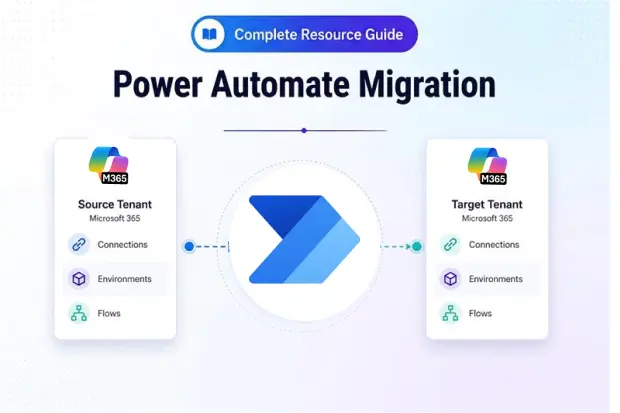
A specialized deep-dive into how connectors behave during cross-tenant migration and which Power Platform environments can be migrated with Apps4.Pro Migration Manager.
Introduction: The Hidden Complexity Behind Every Flow Migration
Power Automate flows are deceptively simple to build but surprisingly difficult to move between tenants. When an organization undergoes a merger, acquisition, divestiture, rebrand, or tenant consolidation, the Power Platform estate rarely gets the attention it deserves until cutover day – at which point hundreds or thousands of automations need to land cleanly in a new Microsoft 365 tenant without breaking business operations.
Two factors drive nearly every Power Automate migration failure: connector authentication and environment mismatch. A flow’s logic (triggers, actions, conditions, expressions) is portable – it’s just JSON. But the connections that sit underneath those actions are bound to user identities, OAuth tokens, and tenant-specific resource IDs that do not travel across tenant boundaries. Similarly, the Power Platform environment a flow lives in – Production, Sandbox, Default, Developer, Trial, or Teams – dictates licensing, security, and data-loss-prevention behavior in ways that must be mapped deliberately during migration.
This guide is the companion resource to our Complete Guide to Power Automate Migration. It focuses exclusively on the two areas where Apps4.Pro Power Automate Migrator delivers the most value: connector auto-mapping and environment-level migration coverage.
- Why Connectors Are the #1 Migration Challenge
- Standard vs. Premium vs. Custom Connectors
- Power Platform Environments: Which Can Be Migrated?
- Auto-Mapping Reference Table
- How Reconnection Works After Migration
- Troubleshooting: Connectors Not Working After Migration
- Frequently Asked Questions
- Keep Exploring
Why Connectors Are the #1 Migration Challenge
When flows are migrated between tenants, the flow definition moves cleanly but the connection references underneath must be rebuilt, remapped, or recreated in the target tenant. This is why “my flows migrated but nothing runs” is the most common post-migration complaint.
Every connection in Power Automate carries three pieces of state that are inherently tenant-bound:
- Identity - the UPN or service principal that authenticated the connection
- Token - the OAuth refresh token issued by the source tenant’s Azure AD
- Resource binding - the specific site URL, mailbox, team, or database the connection points to
None of these transfer natively when a flow is exported and imported into a new tenant. Without a migration tool that understands how to remap them, admins are left to rebuild every connection by hand – often across thousands of flows. Apps4.Pro Migration Manager solves this through automated connector mapping and environment-aware migration.
Standard vs. Premium vs. Custom Connectors
Not all connectors behave the same way during a cross-tenant migration. Understanding the three categories is essential before you plan a move.
| Connector Type | Examples | Migration Behavior | Action Required |
|---|---|---|---|
| Standard | SharePoint, Outlook 365, Teams, OneDrive, Planner, Excel Online | Auto-mapped by Apps4.Pro; re-authentication prompt in target tenant | Sign in with destination-tenant credentials |
| Premium | SQL Server, Dataverse, HTTP, Azure DevOps, Salesforce, ServiceNow | Auto-mapped, but require a Premium license in the destination | Assign Premium licenses before activation |
| Custom | Org-built connectors, third-party APIs, Swagger/OpenAPI connectors | Not auto-discovered – connector definition must be exported and re-imported first | Export custom connector → Import to target → Then migrate flows |
Standard connectors
These are the easiest to migrate because they exist in every Microsoft 365 tenant by default. Apps4.Pro auto-maps them based on matching resource patterns (e.g., a source SharePoint site maps to its equivalent destination site).
Premium connectors
Flow logic migrates identically, but the destination tenant must have Premium licenses assigned before the flows are enabled. Apps4.Pro surfaces a license-gap report during the pre-migration check so licensing can be procured before cutover.
Custom connectors
These require a two-step process: migrate the connector definition first (export from source, import to destination environment), then migrate the flows that depend on it. If the custom connector doesn’t exist in the destination, Apps4.Pro’s validation report flags the dependency before the migration runs.
Power Platform Environments: Which Can Be Migrated?
Apps4.Pro supports migration across every environment type in the Power Platform, with the same fidelity for each. Environment-to-environment mapping is configured directly in the migration wizard – source on the left, destination on the right.
| Environment Type | Cross-Tenant Migration | Typical Use Case |
|---|---|---|
| Production | ✅ Supported | Business-critical flows, live automations |
| Sandbox | ✅ Supported | Pre-production testing, UAT |
| Default | ✅ Supported | Personal productivity flows (every tenant has one) |
| Developer | ✅ Supported | Individual developer builds, PoCs |
| Trial | ✅ Supported | 30-day evaluation environments |
| Teams | ✅ Supported | Flows embedded inside Microsoft Teams channels |
Environment-level coverage includes
- Solution-aware flows and solution-unaware (cloud) flows
- Connection references inside Dataverse solutions
- Environment variables (with value-remapping prompts at migration time)
- Child flows and flow-to-flow dependencies
- Owner and co-owner assignments
- Run history metadata (optional)
Mapping environments intelligently
In most migrations, source and destination environments don’t match 1:1. Apps4.Pro lets you consolidate (e.g., three source Sandbox environments → one destination Sandbox) or split (one source Default → multiple destination environments by department) without breaking flow references.
Auto-Mapping Reference Table
Apps4.Pro’s auto-mapping engine inspects each connection in the source tenant and proposes an equivalent in the destination. You can accept the default or override it per-flow, per-connector, or tenant-wide.
| Source Object | Auto-Mapped To | Example |
|---|---|---|
| Owner (user UPN) | Matching UPN in destination | jane@contoso.com → jane@fabrikam.com |
| SharePoint site URL | Mapped destination site | contoso.sharepoint.com/sites/HR → fabrikam.sharepoint.com/sites/HR |
| SharePoint list / library | Same list in mapped site | /Lists/Tickets preserved |
| Teams team / channel | Equivalent team in target | “Finance – General” → “Finance – General” |
| Dataverse table | Same table in destination environment | account → account |
| Outlook mailbox | Destination user mailbox | svc-automation@contoso → svc-automation@fabrikam |
| Approval connector | Re-bound to destination approver | Approver UPN remapped |
| OneDrive folder | Destination user’s OneDrive path | /Shared Documents/Automation preserved |
| Environment variable | Prompt to enter destination value | API keys, endpoint URLs, secrets |
| Custom connector reference | Pre-imported custom connector in target | Matched by connector name + API definition |
Mappings are saved as a reusable profile – so a tenant-wide migration running over multiple waves doesn’t require re-configuration each time.
How Reconnection Works After Migration
- Flows land in the destination environment in a disabled state by default.
- Apps4.Pro displays a connection status panel showing which connections need re-authentication.
- Admins sign in once per connector type; credentials are bound to the destination tenant.
- Flows are enabled in bulk or selectively after validation.
This disabled-by-default posture is deliberate – it prevents duplicate runs firing against live data while the cutover is still in progress.
Troubleshooting: Connectors Not Working After Migration
The three most common post-migration connector issues and their fixes:
- “Connection not found” - The connection reference points to a source-tenant resource. Open the flow, edit the connection, and select the auto-mapped destination connection.
- “Invalid credentials / token expired” - Expected behavior. Re-authenticate once per connector type in the destination tenant.
- “Connector not installed in this environment” - A custom connector wasn’t pre-migrated. Import the connector definition into the destination environment first, then re-validate the flow.
Frequently Asked Questions
Flow definitions migrate automatically, but the connection credentials behind each connector do not – Microsoft ties them to the source tenant’s identity. Apps4.Pro auto-maps the connector references and prompts for one-time re-authentication in the destination tenant.
All standard environment types – Production, Sandbox, Default, Developer, Trial, and Teams – are supported as both source and destination.
Keep Exploring
- The Complete Guide to Power Automate Migration - start here for the full methodology
- Migrating Cloud Flows Across Tenants - deep-dive on solution-aware vs. cloud flows
- Power Automate Migration for Mergers & Acquisitions - the M&A playbook
- Scope & Supported Objects Reference – the authoritative scope matrix
Ready to Migrate With Confidence?
Explore Apps4.Pro Power Automate Migrator →
Free trial – No credit card required – Migrate your first 10 flows on us

















 Migrate
 Manage
 Migrate Microsoft 365